Federal funding for commercial EV charging arrives through several channels that work very differently from one another. Some are automatic tax credits that need no application. Others are competitive grants with strict eligibility rules, and two of them have been through significant turbulence over the past year. Understanding the landscape helps you identify which programs fit your project, in what order to pursue them, and which ones you can actually rely on right now.
The 30C commercial tax credit: now closed
⚠️ Note: The federal 30C charger tax credit ended June 30, 2026. No federal EV charger tax credit is available for equipment placed in service after that date; budget the real out-of-pocket cost and look to state and utility programs. The description below records how the credit worked, which still matters for any project placed in service on or before that date.
What it was: A federal tax credit covering qualified commercial EV charging equipment and installation costs, up to $100,000 per single item (each installed port).
The rate depended on labor compliance:
- 6% base rate for projects that did not meet prevailing wage and apprenticeship (PWA) requirements.
- 30% rate for projects that did meet PWA requirements. For any project of meaningful size, the five-times difference made PWA compliance worth pursuing.
Who it was for: Almost any commercial entity installing EV charging: multifamily, office, retail, hospitality, fleet, or public sites. There was no competitive application; you claimed it on your federal return.
The eligible-census-tract gate. This was the single most-missed disqualifier. Under the law while 30C was in effect, 30C property only qualified if it was placed in service in an eligible census tract, defined as either a low-income community under the New Markets Tax Credit rules or a non-urban census tract. Affluent suburban locations were the most likely to be ineligible. Note: this was a baseline eligibility requirement, not a bonus. A common misconception was that 30C carried energy-community or low-income "bonus adders." It did not. (More on that below.)
Eligible cost basis:
- Charging equipment (hardware)
- Installation labor
- Electrical infrastructure directly attributable to the charger (new sub-panel, conduit, wiring)
- Does NOT include general electrical upgrades serving other loads, or unrelated construction work
Basis reduction when you stacked. If you also received a tax-exempt state grant or utility rebate for the same project, that amount generally reduced the basis on which you calculated the 30C credit. The same basis rule governs any federal credit you stack a grant against today. See Stacking Incentives.
Elective pay for tax-exempt entities. Tax-exempt organizations, including churches, nonprofits, schools, and governments, could claim 30C through elective pay (sometimes called direct pay), with Treasury paying the credit amount directly to the entity instead of reducing tax liability. That applied to equipment placed in service on or before June 30, 2026.
How it was claimed: File the current version of IRS Form 8911 (with a Schedule A for each port) with your federal return for the year the project was placed in service. Keep installation invoices, equipment receipts, and prevailing wage documentation. Confirm the current forms with a tax professional if you are filing for a qualifying 2026 project.
What it is: The National Electric Vehicle Infrastructure (NEVI) Formula Program, created by the 2021 Infrastructure Investment and Jobs Act, allocated roughly $5 billion to states over five years to build EV charging along designated Alternative Fuel Corridors (AFCs).
2025-2026 status (read this before you plan around NEVI). NEVI was effectively frozen for much of 2025. After a January 2025 change in administration, the Federal Highway Administration suspended approval of state deployment plans and withheld access to funds, and a coalition of states sued. FHWA ended the pause with new interim final guidance on August 11, 2025, and on October 1, 2025 apportioned $885 million for fiscal year 2026, the final year of NEVI formula money. On January 23, 2026, a federal judge in the Western District of Washington (Washington v. U.S. Department of Transportation) ruled that the agencies had acted unlawfully under the Administrative Procedure Act. The court vacated FHWA's 2025 suspension and rescission, restored previously approved plans, and barred withholding outside the governing statute; states still had to satisfy plan, obligation, and procurement requirements. As of Q2 2026, several states have reopened solicitations and more have signaled rounds coming in 2026. The practical takeaway: NEVI is moving again, but the timeline and program rules are less settled than they were before the freeze. Confirm your state's current solicitation status directly.
After September 30, 2026: no new NEVI money, but nothing clawed back. The IIJA appropriated NEVI's $5 billion as $1 billion a year for fiscal years 2022 through 2026, "to remain available until expended." Fiscal 2026 ended September 30, 2026. The continuing resolution signed September 2, 2026 (H.R. 6500) extends federal highway programs to December 11, 2026 at prorated fiscal 2026 levels but provides no fiscal 2027 money for NEVI, and the House committee's five-year reauthorization bill (H.R. 8870, approved in committee May 22, 2026) contains no NEVI funding as introduced. Because the money does not expire, grants FHWA has already obligated (under FHWA's accounting, when FHWA and the state sign the project agreement) are unaffected by the date, and balances a state has not yet obligated stay available for its remaining rounds, provided the state has an FHWA-approved plan and is carrying it out; the IIJA lets FHWA, after notice and a chance to cure, withdraw funds from a state that is not and award them to local governments in that state. The larger exposure is to Congress: unobligated balances are what it redirected in February, and the administration's fiscal 2027 budget request proposed canceling $4.2 billion in unobligated NEVI and CFI funds, a proposal Congress had not enacted as of September 30, 2026. If your project is selected but not yet under a signed agreement, treat getting to an obligated federal share as the priority. NEVI State Round 2 Solicitations walks through awarded grants versus grants in review.
The funding picture is narrower than the original $5 billion suggests. The Consolidated Appropriations Act, 2026, signed February 3, 2026, redirected $878.756 million in unobligated NEVI money to other highway programs: $503.756 million from the states' formula balances (taken in proportion to each state's unobligated fiscal 2022 balance as of January 31, 2026), $300 million from the NEVI set-aside for states and localities needing extra help, and $75 million designated for the Joint Office of Energy and Transportation. In its June 16, 2026 report, the Congressional Research Service put obligations at $1.4 billion of the $4.2 billion made available, as of December 31, 2025, both figures predating the February transfer; it listed ten jurisdictions without an approved FY2026 plan, while twelve states had certified full Alternative Fuel Corridor buildout. Remember that apportionment is not the same as an open state solicitation or an award: dollars apportioned to your state fund no specific project until the state runs a procurement and obligates them. Check driveelectric.gov/states for each state's current plan status.
What the updated guidance says. FHWA's August 11, 2025 interim final guidance keeps NEVI funds on projects along designated Alternative Fuel Corridors until a state certifies full corridor buildout; certification controls when funds may move beyond the corridors, not which project types are eligible. The guidance directs states to determine station spacing based on travel patterns, grid capacity, geography, and cost, and medium- and heavy-duty charging and station upgrades are eligible uses of NEVI funds.
Who administers it: Each state received formula funds. State DOTs and energy offices run competitive grant processes. You apply to your state, not to the federal government.
Who it is for: Owners and operators installing public DC fast charging on or near designated highway corridors. This is a road-trip charging program, not a workplace or multifamily program.
Grant amount: Up to 80% of eligible project costs (as of Q2 2026). A private contractor can sometimes cover the 20% non-federal match.
Core eligibility requirements (verify against your state's current RFP):
- DCFC hardware rated at a minimum of 150 kW per port
- Minimum of 4 charging ports per location
- Located within 1 mile of a designated AFC exit
- Publicly accessible, with no fleet, membership, or employee-only restriction
- Accepts credit and debit cards without requiring a network membership
- Network connectivity and uptime requirements (commonly 97% or higher)
- Buy America provisions in some states
To find your state's program: Search "[state] NEVI program" or check your state DOT site. The Joint Office of Energy and Transportation maintains a state tracker, and your state page on this site summarizes current NEVI program status, designated corridors, and stackable state grants where known.
Not for: Employee or fleet charging, multifamily or office buildings, Level 2 installations, or sites well beyond a designated corridor.
For what a NEVI-funded corridor DCFC site actually pencils to, including the no-NEVI scenario and demand-charge sensitivity, see DC Fast Charging ROI: Why the Math Is Different. The Level 2 equivalent is Building a Realistic ROI Model for Commercial Level 2 Charging.
CFI: Charging and Fueling Infrastructure grants
What it is: The CFI discretionary grant program, also created by the IIJA, was designed to fund up to $2.5 billion in projects, with two tracks: a Community track (charging in publicly accessible community locations, with emphasis on underserved, rural, and tribal areas) and a Corridor track (charging along national highway corridors, including sites that do not fit NEVI).
2025-2026 status. CFI awarded three rounds totaling roughly $1.78 billion before being paused. Do not build a project plan around a new CFI round until FHWA publishes a fresh solicitation. Treat CFI as dormant for planning purposes today.
Status as of June 16, 2026: CFI remained paused and FHWA listed no estimated date for another NOFO. The Congressional Research Service reports that OMB directed FHWA on February 10, 2026 to withhold or cancel about $135 million in previously selected awards, affecting projects in California, Colorado, Illinois, and Minnesota; those four states amended their lawsuit on March 3. Litigation is ongoing, and the final disposition of each award should be confirmed with the grantee and FHWA.
Who administers it: The Federal Highway Administration, in partnership with the Department of Energy. These are national competitive grants, not formula funds.
Grant amount: Historically up to 80% of eligible project costs, with criteria that varied by round.
Who should watch CFI (if and when it reopens):
- Government entities (cities, counties, transit agencies)
- Nonprofits with community-access locations
- Properties in designated disadvantaged communities
- Rural sites that do not qualify under NEVI
How to track it: Watch Grants.gov and the FHWA CFI page. Subscribe to FHWA notifications so you hear about a new round when it opens.
IRA clean-energy credits: what actually applies to chargers
The Inflation Reduction Act created and expanded several credits. It is important to be precise about which ones touch EV charging, because the field is full of overstated claims.
The 30C credit was the IRA's main EV-charging tool. It is described above. The IRA set its original 30% rate, the PWA structure, the eligible-census-tract rule, transferability, and elective pay. OBBBA then moved the expiration up to June 30, 2026, which has now passed, so the credit is closed.
Bonus adders do NOT apply to 30C. The energy community bonus and the low-income communities bonus credit (LICBC) are frequently and incorrectly described as boosting the 30C rate. They do not. Those adders attach to the clean-electricity production and investment credits (Sections 45, 45Y, 48, and 48E), which cover generation and storage assets like solar, wind, and batteries. Section 30C is not on that list. If you see a claim that your charger qualifies for a "10% energy community bonus on the 30C credit," it is wrong. See IRA Bonus Credits for EV Charging in Low-Income Communities for the full explanation of where the confusion comes from and where the adders genuinely help.
Where IRA bonus adders can still help an EV project. If your charging installation is part of a larger project that includes its own qualifying generation or storage, for example solar canopies plus battery storage feeding the chargers, the ITC on the solar-plus-storage portion can qualify for energy-community or low-income adders. The adder applies to the generation and storage assets, not the chargers. This requires deliberate structuring and energy tax counsel.
Step-by-step: how the 30C commercial credit was claimed
The 30C credit needed no grant application; you claimed it on your return. The credit ended June 30, 2026, so this process now applies only to qualifying projects placed in service on or before that date.
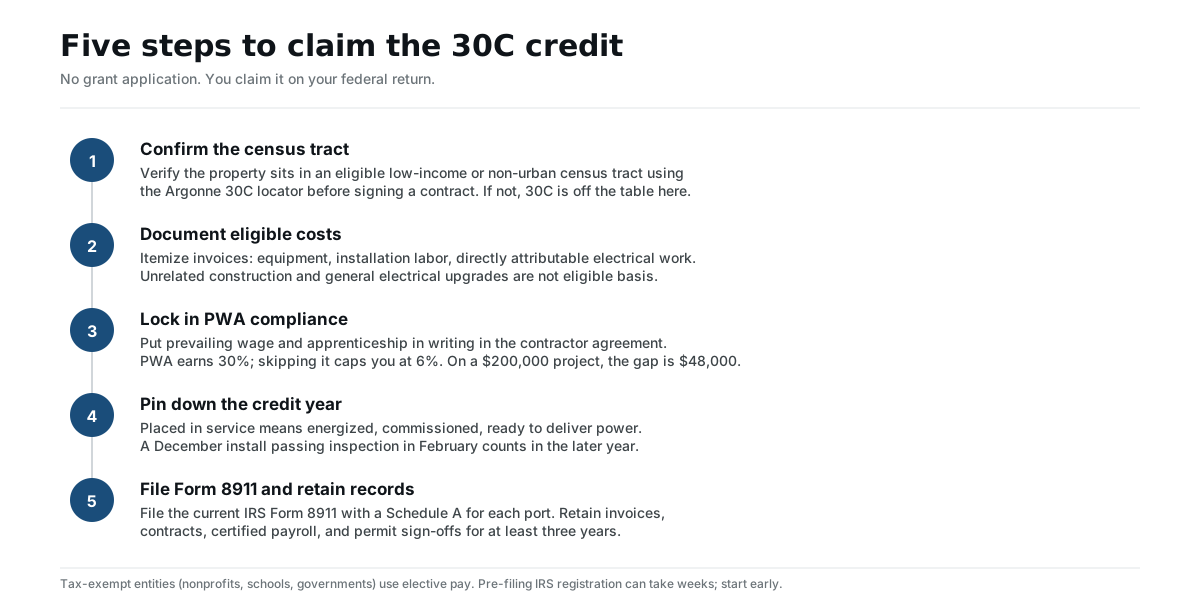
A few details worth calling out alongside the visual. For Step 3, Davis-Bacon prevailing wage rates applied; verify current rates at dol.gov. For Step 4, the placed-in-service distinction was decisive given the June 30, 2026 cutoff: an install that passed final inspection after that date fell outside the credit entirely. For Step 5, retain large-credit records longer than the three-year minimum.
Worked example (how a qualifying project computed while the credit was live): A 12-port Level 2 commercial install in an eligible census tract, $200,000 total eligible cost, PWA-compliant:
- 30% of $200,000 = $60,000
- Per-port cap of $100,000 not reached on any port
- Credit: $60,000
The same project without PWA compliance would earn 6%, or $12,000. That $48,000 gap is the reason PWA compliance is worth the documentation effort.
How to prioritize and combine these programs
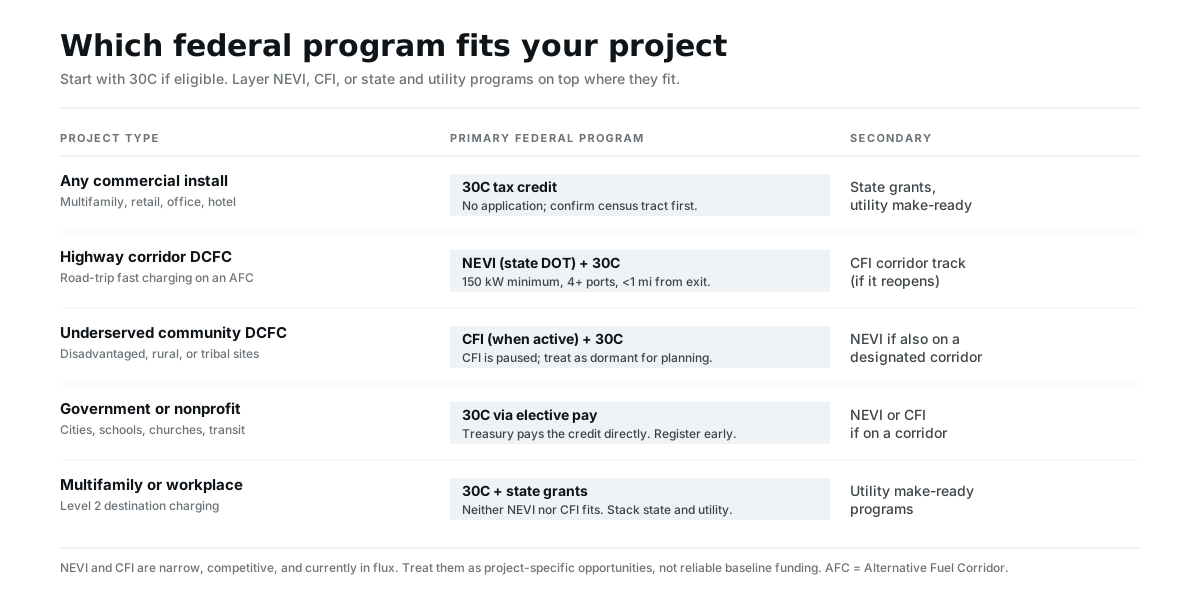
The 30C credit was the starting point for nearly any commercial project while it was available, but it ended June 30, 2026, so it is no longer part of a new project's funding plan. NEVI and CFI are narrow, competitive, and currently in flux, and NEVI has no new money scheduled after fiscal 2026, so treat them as project-specific opportunities rather than reliable baseline funding; for most commercial projects the funding plan now rests on state and utility programs.
For the full picture on combining federal credits with state and utility programs, see Stacking Incentives.
Last factually verified: September 30, 2026 for the NEVI section, against the Infrastructure Investment and Jobs Act (Public Law 117-58, division J, title VIII), the Consolidated Appropriations Act, 2026 (Public Law 119-75, division D, title I), the enrolled text of H.R. 6500 and the White House notice of its September 2, 2026 signing, the introduced text of H.R. 8870, Congressional Research Service report R48996 (June 16, 2026), FHWA's fiscal 2026 NEVI apportionment notice (N 4510.909, confirmed through FHWA's published summary because the notice returned an access error), and AASHTO Journal coverage of the continuing resolution; congress.gov and highways.dot.gov returned access errors, so bill and statute text was read from govinfo.gov. The rest of the article was last verified May 24, 2026 against the IRS (Form 8911 and 30C guidance), Argonne National Laboratory 30C eligibility resources, the Alternative Fuels Data Center (NEVI), FHWA CFI program pages, the January 2026 ruling in Washington v. U.S. Department of Transportation, and clean-energy tax analyses of OBBBA (Grant Thornton, Steptoe).
evcharginghelp.com is editorially independent and receives no compensation from any company mentioned.
Corrections (August 11, 2026): This article previously said only that previously announced CFI awards in some regions had faced uncertainty. Per the Congressional Research Service, OMB directed FHWA on February 10, 2026 to withhold or cancel about $135 million in previously selected CFI awards affecting projects in California, Colorado, Illinois, and Minnesota; those four states amended their lawsuit on March 3, and litigation is ongoing.
Corrections (September 30, 2026): This article previously said FHWA apportioned the fiscal 2026 NEVI money and issued updated guidance after the January 23, 2026 court ruling; FHWA ended the pause with its August 11, 2025 interim final guidance and apportioned $885 million on October 1, 2025, both before the ruling. It also previously dated the Congressional Research Service's $1.4 billion obligation figure to June 16, 2026; that is the report's date, and the figure is as of December 31, 2025.