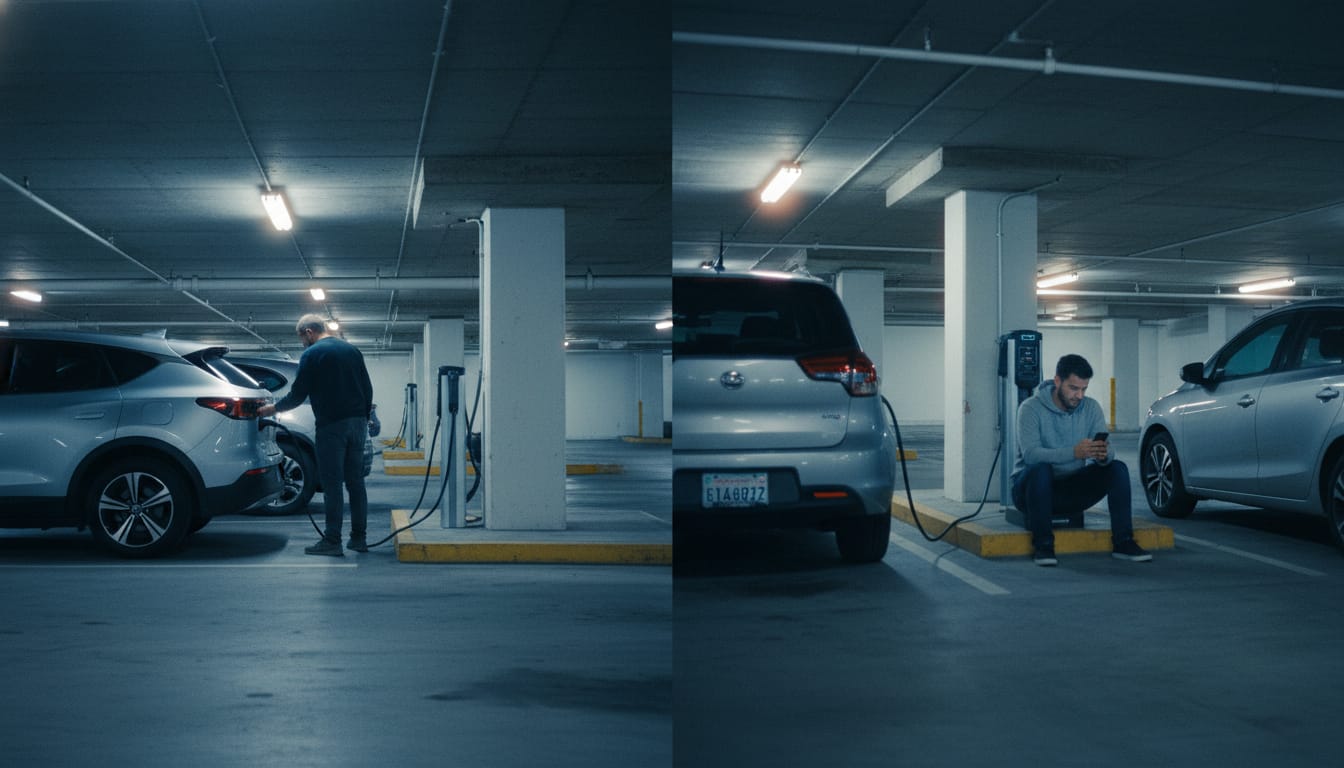
California has required EV infrastructure in new construction for years, so the headline is not that the requirement exists. The headline is that the 2025 code edition, in force across the state since January 1, 2026, meaningfully raised the bar. Developers who treat EV provisions as a 2021-era checkbox risk plan-check corrections and inspection delays under the new edition. Here is what the rules require, what specifically changed, and where projects go wrong.
The three tiers in CALGreen terms
California's requirements live in two related instruments: the Title 24 Building Energy Efficiency Standards (Part 6) and CALGreen (Part 11). Together they define three escalating levels of EV provision in new construction.
- EV-capable: raceway and reserved panel capacity to a parking space, so charging can be added later. No wiring pulled.
- EV-ready: the branch circuit run and terminated at the space, ready for a charger to be mounted.
- EVSE-installed: an operational charging station actually installed and energized at the space.
A single project carries a blend: some spaces installed, some EV-ready, some EV-capable, set by a scoping table keyed to building type and parking count.
What the earlier (2022) code required
For context, the 2022 CALGreen edition (effective January 1, 2023) required new nonresidential buildings with parking to provide EV-capable spaces for a substantial share of parking, scaled by lot size, with a smaller share of those required to be EVSE-installed. For the largest lots (201 or more spaces), the baseline text carried into the 2025 express terms shows 20 percent of spaces as EV-capable and 25 percent of those as EVSE-installed; see the table in the adopted code for smaller lots. New multifamily was broadly EV-capable or EV-ready depending on whether parking was assigned (a residential requirement published by the Department of Housing and Community Development, HCD, in the same code cycle). The emphasis was on capability: get the conduit and capacity in, install fewer actual chargers.
What the 2025 code changed (effective January 1, 2026)
The 2025 edition shifts the emphasis from "capable" to "installed," which is the substantive change developers need to budget for.
Nonresidential scoping split by use. The nonresidential scoping was restructured around Table 5.106.5.3.1, which now treats office and retail uses differently from other nonresidential uses, and in both categories it moves a substantially larger share of EV spaces from capable-only to installed EVCS. One thing this article deliberately does not do is restate the numbers: it is a high-level summary of what changed, not a compliance guide, and you cannot establish compliance from a summary. The binding figures are the counts in Table 5.106.5.3.1 and the accompanying power-allocation table in the adopted 2025 CALGreen code, keyed to parking count, occupancy, and measure. Pull the applicable cells from the adopted code text via the official California code publication portal before you design or budget. Submit the load letter to the utility early, since service upgrades set the schedule.
Power allocation tightened. The 2025 table has separate Office/Retail and Other-than-Office/Retail columns, and the tightening happens in two different footnotes, not one across-the-board cut. In the power allocation method table (Table 5.106.5.3.6), one footnote reduces the maximum kVA that may be used for EV-capable spaces from 75 percent to 50 percent; a different footnote caps that share at 25 percent for office and retail buildings. Identify your occupancy's column in the adopted table to see which limit applies to your project. Practically, this limits how much you can lean on automatic load management to stretch a thin service across many capable spaces, and it pushes toward provisioning real capacity.
Multifamily. New multifamily must be broadly EV-ready, and the 2025 edition adds an adopted installed-charger requirement, not just an expectation. Under Section 4.106.4.2.2, published by HCD, in addition to the low-power Level 2 receptacle requirements, 25 percent of unassigned or common-use parking spaces must be equipped with Level 2 EV chargers made available for use by all residents or guests. Note the code's distinction between a low-power Level 2 EV charging receptacle and an installed Level 2 EV charging station (EVCS); they are separate measures and one does not substitute for the other. The rules also differ for assigned versus unassigned parking, an automatic load management system (ALMS) is an available compliance option, and the section carries its own exceptions. These requirements arrive with the code effective January 1, 2026; confirm local amendments and which code cycle governs your permit application.
The net effect: a 2026 nonresidential project costs more to comply than the same project did under the 2022 code, because more spaces must carry pulled wire and mounted equipment rather than empty conduit, and you can allocate less of your power budget to capability-only.
What enforcement looks like in practice
Inspectors verifying EV compliance check for:
- A panel schedule showing dedicated, correctly sized capacity for the EV circuits
- Conduit installed per the design drawings, at the right size and routing
- Junction boxes, receptacles, or stub-outs at the marked EV spaces, matching the required tier
- For installed-EVSE counts, actual energized equipment, not a promise to add it later
- Required signage and space marking
Early enforcement (the 2020 to 2022 window) was uneven; inspectors were learning the requirements alongside builders. That has changed. EV compliance is now a standard checklist item, inspectors know what to look for, and the higher 2025 installed-share requirements give them more concrete items to fail. Under-provisioning, or trying to satisfy an installed-EVSE requirement with capable-only conduit, can cause plan-check corrections or inspection delays. The cost of those delays usually dwarfs the cost of building it right the first time.
Don't confuse code with accessibility or incentives
Two adjacent topics get tangled with Title 24 and shouldn't be:
- Accessibility is separate. California's EV-charging accessibility rules live in Chapter 11B of the Building Code, and they impose their own scoping and dimensional requirements on accessible charging spaces. Meeting the Title 24 EV count does not satisfy Chapter 11B, and vice versa. You must satisfy both. See the ADA requirements article.
- Incentives are separate. Programs like CALeVIP and utility make-ready can fund charging, but qualifying for a rebate is not the same as meeting code, and meeting code does not earn a rebate. Code is the floor; incentives reward going beyond it.
What developers should do
- Design to the 2025 table from the start. Any project permitted in 2026 is under the new edition. Pull the exact cell for your building use and parking count early.
- Budget for installed EVSE, not just conduit. The shift from capable to installed is the main cost change; pricing it as a 2022-era capable-heavy build will come up short.
- Right-size the service for the reduced power-allocation flexibility. With less budget allowable for capable-only spaces, plan real capacity.
- Coordinate Title 24 and Chapter 11B together so accessible charging spaces satisfy both the EV count and the accessibility code.
- Document everything in the permit set; the drawings and inspection records are your compliance evidence.
The national context
California's Title 24 approach is the template other states adapt, and the federal direction is toward broader and stricter requirements rather than looser ones. A developer who builds to the 2025 California standard anywhere is generally ahead of where most other jurisdictions' codes are heading, which makes the California approach a reasonable design hedge even outside California. The expensive moment is always the retrofit, and the 2025 code is a reminder that the minimum keeps moving up.
Last factually verified: 2026-10-17 against the California Building Standards Commission final express terms for the 2025 CALGreen (BSC 03/24; nonresidential Table 5.106.5.3.1 and power-allocation Table 5.106.5.3.6, including their footnotes) and the Department of Housing and Community Development final express terms (HCD 04/24; multifamily Section 4.106.4.2.2). The 2025 CALGreen is listed by the Building Standards Commission as effective January 1, 2026. The July 1, 2024 supplement to the 2022 code was not reviewed. Exact percentages vary by building use and parking count; confirm the applicable code-table cell with your AHJ.
Corrections (August 11, 2026): This article previously gave approximate installed-EVSE shares for the 2025 nonresidential scoping (roughly three-quarters for office and retail, roughly half for other uses); those shorthand ratios have been removed because the binding numbers are the counts in Table 5.106.5.3.1 and the power-allocation table of the adopted 2025 CALGreen code, and the article is now framed as a change summary that points to those tables. It previously described the power-allocation change as a single reduction from about 50 percent to about 25 percent; the 2025 table has separate columns, with one footnote reducing the EV-capable share from 75 percent to 50 percent and another capping the applicable office/retail EV-capable column at 25 percent, reserving 75 percent for installed EVCS. It previously described the multifamily requirement as an expectation of a Level 2 receptacle per dwelling unit; under Section 4.106.4.2.2, parking spaces not supplied by low-power Level 2 receptacles, plus common-use parking, must receive Level 2 EV chargers at 25 percent of those spaces, up from 10 percent.
Corrections (October 17, 2026): The 2022 nonresidential description now reflects the table baseline in the 2025 express terms (20 percent of spaces EV-capable for the largest lots, instead of "roughly 30 percent"). The power-allocation footnotes are attributed to Table 5.106.5.3.6, where they appear. The multifamily requirement is stated as 25 percent of unassigned or common-use spaces, attributed to HCD; the earlier "spaces not supplied by low-power Level 2 receptacles" base and the "up from 10 percent" comparison were removed because the express terms do not use that base.