EV Charging Insurance for Commercial Property Owners
Adding chargers to your property creates risks your existing policies were never written to handle. Confirm your coverage line by line before you install, because the worst time to find a gap is after a claim.
This is general information, not personalized insurance or legal advice. EV Charging Help is editorially independent. We do not sell insurance and we do not earn commissions from carriers. Coverage terms, state laws, and what insurers are willing to write all change frequently. Talk to a licensed insurance professional and qualified counsel about your specific situation before you act.
The short version
Hosting EV charging stacks several risks on top of one another, and the biggest potential gaps are predictable: lithium-ion battery fire, environmental cleanup after a fire, cyber exposure on networked chargers, and copper cable theft. Whether a standard commercial property policy and a standard general liability policy respond to each of these turns on the actual forms, endorsements, exclusions, causation, and jurisdiction, so treat every one as a question to put to your broker in writing rather than an assumption in either direction; some carriers are also starting to limit or condition the fire exposure specifically.
The decision that matters most is your operating model. If you own and operate the chargers, almost all of the risk lands on you. If a third-party operator runs them, you can transfer much of it by contract, but only if the indemnification, additional insured status, and certificates of insurance are written correctly and verified before any work starts.
Why your current policies don't fully cover it
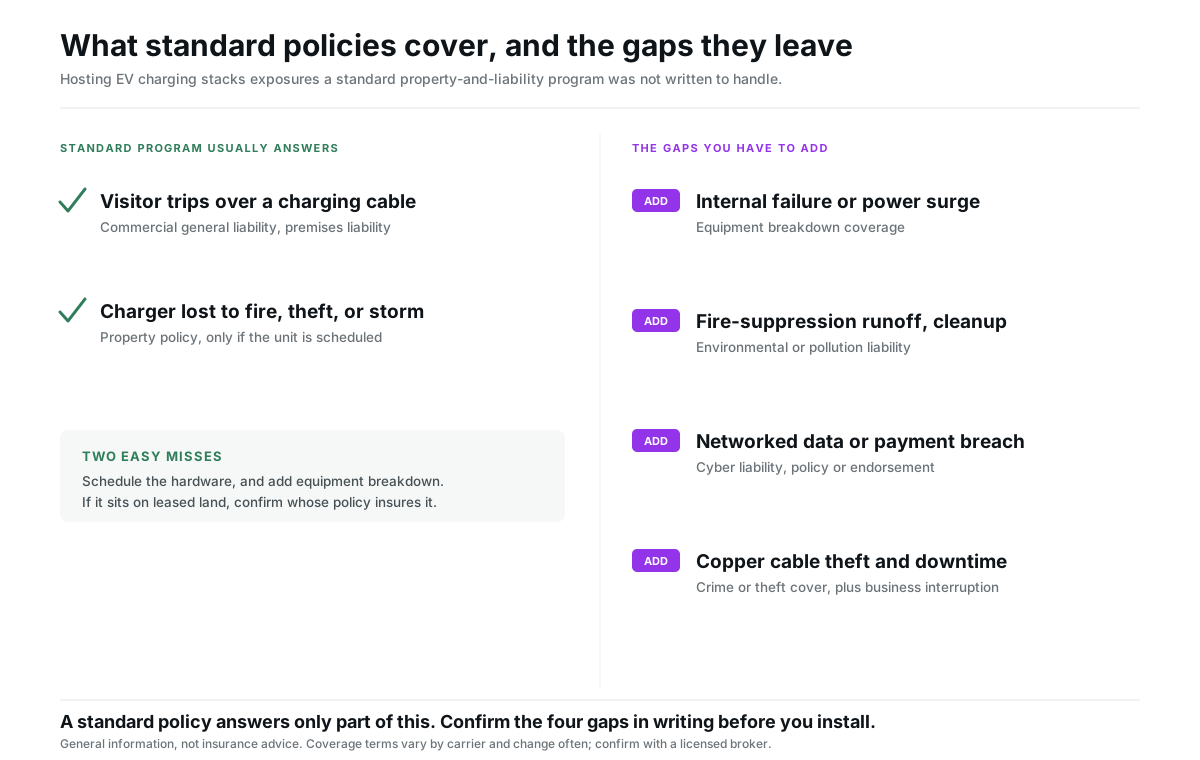
A commercial general liability (CGL) policy covers third-party injury and property damage. A commercial property policy covers your buildings and contents against fire, theft, and weather. Neither was designed around a 480-volt cabinet that pushes high current into a lithium battery in your parking lot.
The result is a set of potential gaps that have to be confirmed form by form. CGL usually responds when a visitor trips over a charging cable, but it does not cover damage to your own charger and it does not cover injuries to your employees, which fall under workers' compensation. Property policies generally cover fire, but many forms carry pollution exclusions that can reach the environmental cleanup an EV fire can trigger, and internal electrical and mechanical failures are commonly excluded; whether yours does either turns on the exact form and its endorsements. Networked chargers add a data and payment exposure that standard property and liability forms are usually silent on.
None of this means you cannot insure charging. It means you have to assemble the right combination of coverages and confirm each one rather than assume your existing policy already responds.
The coverages you actually need
General and premises liability
As a property owner or operator, you owe people who use your property a reasonably safe environment. Someone tripping over a charging cable, slipping near a stall, or being injured while charging is a premises liability claim, and CGL is the policy that answers it. Commercial counterparties commonly require limits of $1 million per occurrence and $2 million aggregate, with an umbrella layer above that. Confirm that charging-related injuries are within scope and not carved out by an exclusion.
Property coverage plus equipment breakdown
You can schedule the charging hardware on a commercial property policy so it is covered for fire, theft, vandalism, wind, and lightning. The insurance marketplace Insuranks puts typical commercial property limits for charging businesses at $25,000 to $500,000, but no published range fits every site: set your limit at the full cost to replace the hardware and its installation, and confirm it with your broker.
Two pieces are easy to miss. First, add equipment breakdown coverage, which handles the internal electrical and mechanical failures and power surges that standard property forms exclude. Second, if your charger sits on someone else's property, it is usually covered by that party's policy rather than yours, so confirm who is actually insuring the hardware. During the build itself, an installation floater or builders-risk form covers the equipment in transit and while the work is underway.
Environmental and pollution liability
This is the gap most property owners do not see coming. When firefighters suppress an EV battery fire, the runoff can carry heavy metals and, depending on the foam used, PFAS chemicals into storm drains, soil, and water. Brokers including Propel Insurance flag that CGL, property, and umbrella forms commonly carry pollution exclusions, but whether your program responds turns on the actual form, endorsements, exclusions, causation, and jurisdiction, so ask your broker or carrier to identify, in writing, the exact form number, the pollution exclusion or sublimit it carries, and any endorsement that buys coverage back. Cleanup liability often follows the property regardless of fault, and a municipality can pursue the responsible parties for cost recovery. A standalone environmental or pollution liability policy can address this exposure, but it carries exclusions of its own, so review it with the same form-level scrutiny; either way, it is far cheaper to arrange coverage before an incident than to litigate after one.
Cyber liability for networked chargers
Networked chargers collect payment data and communicate over the Open Charge Point Protocol (OCPP) with a charging management system. Documented weaknesses include unencrypted OCPP 1.6 traffic, weak authentication, firmware tampering, RFID skimming, payment fraud, and breaches that expose driver data. Standard property and liability forms usually do not address these, so a cyber policy or endorsement is the right response. On the prevention side, require TLS encryption and current OCPP security profiles, enforce multi-factor authentication on management accounts, patch firmware on a schedule, and keep the charger network separated from your point-of-sale and guest Wi-Fi.
Business interruption
If a covered event takes your chargers offline and charging is a revenue line rather than a free amenity, business income coverage can replace the lost revenue and continuing expenses while you repair. This matters most for pay-per-use sites.
Theft and vandalism, including copper cable theft
Copper cable theft has become a real loss driver. Copper reached a then-record of nearly $5.20 per pound in late May 2024, up about 25 percent from a year earlier, which fueled a wave of cut cables. Prices have since climbed further: COMEX copper set new records above $6.80 per pound in September 2026, so the incentive has not gone away. The economics are lopsided: a thief nets only a small amount per cable, often reported around $15 to $20, but a Minneapolis public works project manager told the Associated Press that a single cable costs about $1,000 to replace. Electrify America reported 129 cut cables across its network through May 2024, already past its total for all of 2023.
Beyond the repair bill, you absorb downtime and lost revenue, and repeated claims can raise your rates or threaten renewal. Mitigations now on the market include cut-resistant and steel-reinforced cables with tamper alarms, detachable or locked connectors, and forensic marking fluids. Note that ordinary misuse, such as drivers dropping or yanking connectors, damages cables too, not just theft.
Who is liable when something goes wrong
When a charging incident produces a claim, several parties can share the blame, and the contract usually decides who ultimately pays.
- The property owner carries premises liability for unsafe conditions you knew about or should have known about.
- The manufacturer can carry product liability if a defect in the charger caused the harm.
- The installer can carry liability for faulty workmanship, often under completed-operations or professional errors-and-omissions coverage. Construction defect claims from rushed Level 2 installs, such as undersized wiring or missing ground-fault protection, are a recurring theme, as the Naumann Law Firm and others have noted in the HOA context.
- The network operator can carry responsibility for the software and payment systems they run.
Plaintiffs' attorneys routinely name all of them and let discovery sort out fault. That is exactly why the contracts you sign with your installer and operator are the real determinant of who absorbs a loss.
Your operating model decides how much risk you keep
There are three common ways to run charging on your property, and they distribute risk very differently. For the business side of the same choice, see our comparison of own-and-operate, turnkey, and hybrid models.
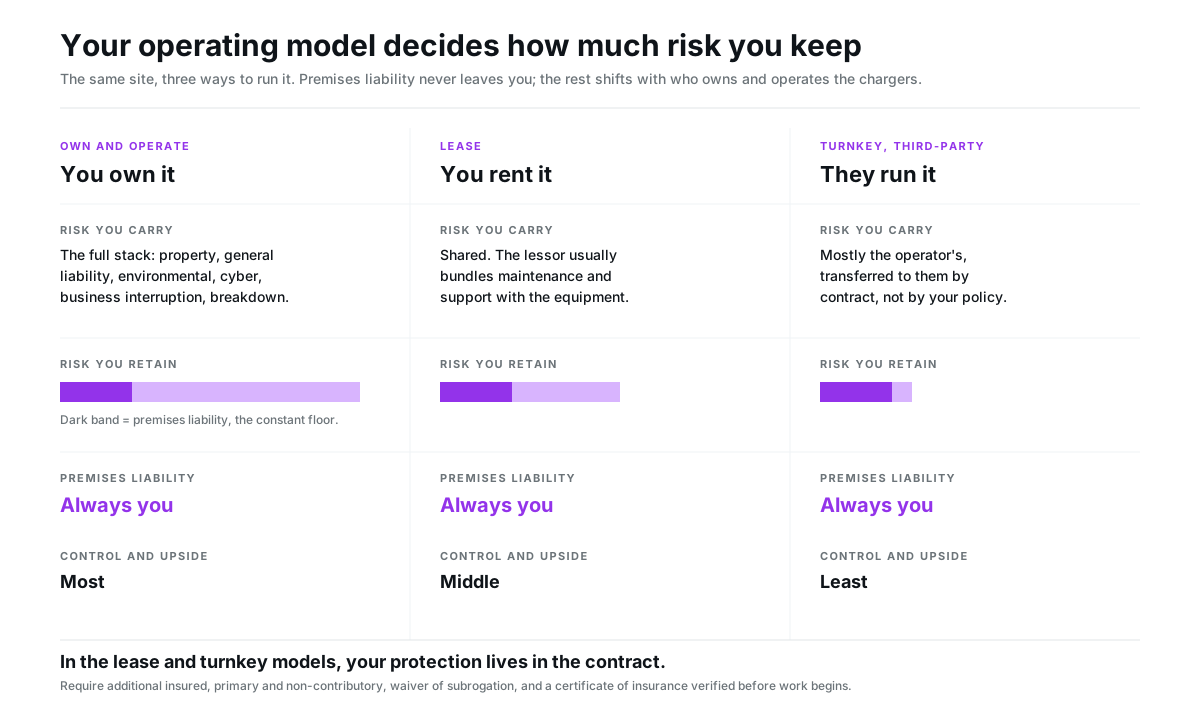
- Own and operate. You buy the equipment and take on the full stack: property, general liability, environmental, cyber, business interruption, and equipment breakdown. Most control, most upside, most risk, most insurance to buy.
- Lease. You pay a monthly fee and the leasing company usually bundles maintenance and support, which shifts some of the operational risk away from you.
- Turnkey or third-party operator. The operator installs, maintains, supports, and ideally insures the chargers, and you provide the space. Least operational burden and least upside, but the equipment still sits on your land, so you keep premises liability no matter what.
In every model you retain premises liability. In the lease and turnkey models, your protection lives in the contract.
Contracts: where risk transfer actually happens
When you work with an installer or operator, the paperwork is the coverage. Require:
- Additional insured status for your entity on their policies.
- Primary and non-contributory wording, so their coverage answers first.
- Waiver of subrogation, so their insurer cannot turn around and sue you.
- Completed-operations coverage, which responds to problems that surface after the work is done.
- Adequate limits, often $1 million per occurrence and $2 million aggregate at minimum, with umbrella above.
- Certificates of insurance verified before work begins, with the correct additional-insured endorsement edition dates. Using the wrong endorsement edition can leave you without the coverage the contract promised.
Spell out, in writing, who is liable for injuries and vehicle damage, who handles maintenance and uptime, who owns breach response and data-breach notification, and who is responsible for removing and restoring the site at end of life.
What underwriters want to see
Insurers treat EV charging as an emerging risk and look closely at fire exposure, siting, equipment quality, installation, maintenance, and cyber controls. Meeting their expectations is also what supports better terms. They generally want:
- Certified equipment. UL 2594 for Level 1 and Level 2 chargers, UL 2202 for DC fast chargers, plus related connector and personnel-protection listings. Unlisted equipment usually cannot be legally installed in permitted work.
- Code-compliant installation. National Electrical Code Article 625, proper grounding and conductor sizing, ground-fault protection, and installation by licensed electricians. The 2023 NEC expanded Article 625 for bidirectional charging and energy-management integration, and the 2026 edition revises it again, so confirm which edition your jurisdiction enforces.
- Physical risk controls. Bollards, wheel stops, cord management, signage, and lighting.
- A maintenance plan. Documented inspection and testing, which matters more for DC fast chargers with liquid cooling and filters.
- Cyber controls on networked units, as described above.
Following these reduces your risk and can influence how an underwriter prices and structures your coverage.
Does it raise your premium, and by how much?
There is no public number for commercial hosts. No carrier or broker publishes a specific surcharge for adding charging, and any precise percentage you see online is almost certainly case-specific. The defensible statement is qualitative: USI Insurance Services warns that insurers may charge higher premiums, restrict or limit coverage, or attach special conditions such as enhanced fire suppression, depending on the perceived fire risk of your site.
One caution on the numbers floating around. You will find figures showing EVs cost substantially more to insure than gas cars, around $3,159 versus $2,218 a year for full coverage, about 42 percent more, in Insurify's 2026 data. That is personal auto insurance for the vehicle, a completely different exposure, and it does not transfer to a property owner hosting chargers.
Level 2 versus DC fast charging
The two are not the same risk. Level 2 runs at 208 to 240 volts and is the typical choice for multifamily, office, and workplace sites. DC fast charging is typically fed by 480-volt three-phase service and delivers direct current at up to about 1,000 volts, carries higher fire and electrocution stakes, needs more maintenance, and costs more to repair after cable theft. A replacement DC fast charger cable can cost several times as much as a Level 2 cable before labor and downtime; get the current replacement price for your specific units from the manufacturer or your service provider. If you move from Level 2 to DC fast charging, treat it as a coverage review, not a swap.
What changes by state
Insurance and the rules around it vary by state. A few that matter:
- California. Civil Code Section 4745 governs charger installation in common-interest developments. SB 770 (Stats. 2025, ch. 525), effective January 1, 2026, amended the section's insurance provisions and removed the earlier requirement that the owner's policy name the association as an additional insured. Insurance obligations remain: under the current Section 4745(f), an owner installing a charger in a common area or an exclusive-use common area must still provide the association a certificate of insurance within 14 days of approval, must maintain a liability coverage policy at all times, and the certificate must be provided annually thereafter; an owner using an existing NEMA-standard AC power plug is not required to maintain the liability policy. Associations can still negotiate additional-insured status in their approval terms, so read the governing documents alongside the current statute. AB 476 (Stats. 2025, ch. 694), signed in October 2025 and effective January 1, 2026, added electric vehicle chargers to the list of stolen public-agency and utility property that scrap metal dealers may not knowingly possess, and raised the maximum criminal fines for scrap dealers who take in stolen or utility-owned metal to $5,000, part of a crackdown on copper theft. CALeVIP offers incentives for publicly accessible DC fast charging, with its next application window opening in October 2026.
- Washington. Under RCW 64.90.513, whose charging provisions reached many communities governed by Washington's older condominium and homeowners' association laws on January 1, 2026, an owner installing a charger must engage an electrical contractor familiar with EV charging installation standards and, within 14 days of approval, provide a certificate of insurance naming the association as an additional insured on the owner's policy. The owner also reimburses any documented increase in the association's premium. The additional-insured certificate requirement does not apply to associations of single-family homes, site condominiums, or planned developments where the units are not immediately adjacent.
- New York. Standard premises, product, and negligence liability rules apply, and claims against public entities carry a 90-day notice requirement. NYSERDA publishes a site-owner best-practices guide.
- Texas and Colorado. Both have documented charger cable thefts, Houston and Denver among them, as do California, Washington, Nevada, Arizona, and others.
- Florida. The commercial property market has started to soften for well-protected inland properties, but coastal and catastrophe-exposed properties still face separate wind layers, large named-storm deductibles, and limited carrier choice. Local fire authorities can also set sprinkler requirements over charging spaces in parking garages that go beyond the base code (San Francisco's fire department, for example, requires a higher sprinkler design over those spaces), so check with your local fire marshal.
How property type changes the exposure
- Multifamily. Chargers are a tenant amenity, and HOA or condo rules, additional-insured norms, and rushed-install construction defects dominate the risk picture.
- Retail and hospitality. High public foot traffic raises the frequency of trip-and-fall and other premises claims, and DC fast charging is common.
- Office and workplace. Usually Level 2, predictable use, lower public exposure.
- Industrial and fleet depots. Highest power and the most concentrated equipment. Clustering many chargers raises the fire load. Nationwide's loss-control guidance cautions against clustering more than five charging spaces without enhanced protection.
A separate point on fire: lithium-ion battery fires behave differently from gasoline fires. They are driven by thermal runaway, can reignite hours or even days after they appear to be out, and are much harder to fully extinguish, often taking many times more water than a burning gasoline car. Widely repeated claims that EV fires burn at a specific temperature, such as 5,000 degrees Fahrenheit, are contested and are not an established NFPA finding, so the point that matters to underwriters is the severity and persistence of the fire, not a headline number. EV fires are statistically rarer than gas-vehicle fires but more severe and harder to extinguish, which is why underwriters focus on them, especially in enclosed structures. The 2022 edition of NFPA 13 reclassified parking garages as a higher hazard and raised the sprinkler design density by about a third, and the 2023 edition of NFPA 88A requires sprinklers in new parking structures, open ones included, which were often exempt before (existing structures are not required to retrofit, and the requirement applies only where a jurisdiction adopts that edition).
Questions to ask your broker before you install
Put these in writing and get written answers that identify the exact form number, exclusion, sublimit, and endorsement behind each one:
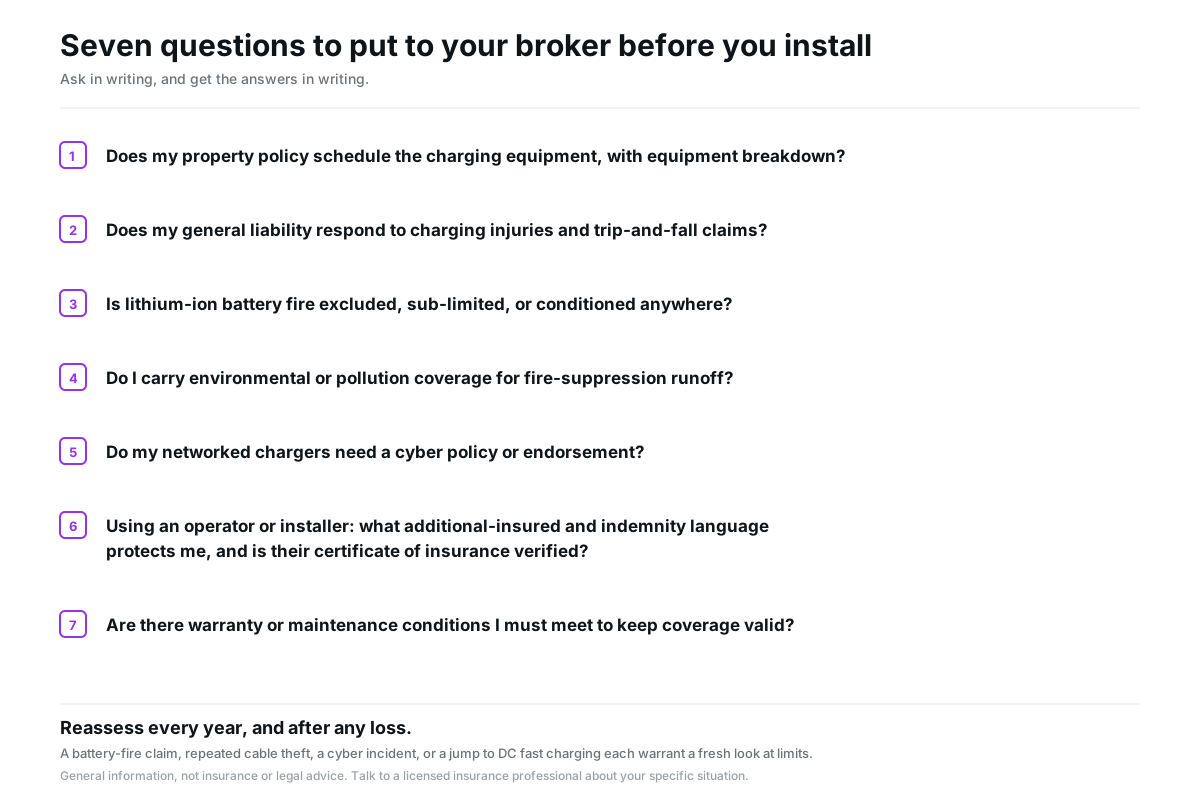
- Does my property policy schedule the charging equipment, and does it include equipment breakdown?
- Does my general liability policy respond to charging-related injuries and trip-and-fall claims?
- Is lithium-ion battery fire excluded, sub-limited, or conditioned anywhere in my policies?
- Do I carry environmental or pollution coverage for fire-suppression runoff?
- Do my networked chargers require a cyber policy or endorsement?
- If I use an operator or installer, what additional-insured and indemnity language protects me, and have I verified their certificate of insurance?
- Are there warranty or maintenance conditions I have to meet to keep coverage valid?
Common mistakes to avoid
- Assuming the existing property or liability policy already covers charging without confirming it.
- Skipping environmental coverage because the property policy mentions fire.
- Letting an installer or operator start work before verifying their certificate of insurance and endorsement editions.
- Treating a move to DC fast charging, a copper-theft loss, or a cyber incident as routine rather than as a trigger to review coverage and limits.
- Using unpermitted or unlicensed installers, which can complicate or jeopardize a claim depending on the policy, causation, and the claim facts.
Reassess your coverage every year and after any loss. Any battery-fire claim, repeated cable theft, a cyber incident, or a jump to DC fast charging should each prompt a fresh look at your limits and your dedicated environmental and cyber coverage.
Sources
- USI Insurance Services, "Electric Vehicles: How to Navigate Heightened Risks and Insurance Challenges" (Q3 2024)
- Propel Insurance, "EV Fires: An Environmental Liability Risk Many Businesses Don't See Coming"
- Risk Strategies, "EV Charging Stations: Risk Management and Insurance Planning"
- ALIGNED Insurance, "Electric Vehicle Charging Station Insurance"
- Insuranks, "Electric Vehicle Charging Station Insurance: Cost & Quotes"
- Nationwide Risk Management, "Electric Vehicle Charging Stations: Minimize Your Risk"
- The Hartford, "EV Charging Stations" program overview
- NIP Group, "Safe and Insured Electric Vehicle Charging Stations" (UtilityPro)
- Naumann Law Firm, "Construction Defect Liability for Faulty EV Charger Installations in HOAs" (Jan 2026)
- Associated Press reporting on EV charger copper cable theft (2024)
- Kite Compliance, "The Standards Landscape for EV Charging in the U.S."
- Insurify, "The EV Premium Penalty" (2026 personal auto EV insurance cost data, cited only to distinguish it from commercial host coverage)
- California Civil Code Section 4745 (as amended by SB 770, Stats. 2025, ch. 525) and Penal Code Sections 496a and 496e (as amended by AB 476, Stats. 2025, ch. 694)
- Revised Code of Washington 64.90.513
- New York General Municipal Law Section 50-e
- National Fire Sprinkler Association, "Fire Sprinklers in Open Parking Garages" (2024), and San Francisco Fire Department Administrative Bulletin 4.29
- Investing News Network and StartupFortune reporting on 2026 COMEX copper records
- District of Columbia Department of Energy and Environment, public EV charging grant insurance requirements (Appendix 6)
- Open Charge Alliance, OCPP Security Operations Guide (January 2026)
- UL 2594 and UL 2202 standard scope statements
- IAEI Magazine, "EV Infrastructure 2.0 and the 2026 NEC" (April 2026)
- CALeVIP program site (California Energy Commission)
- Captives.insure (April 2026) and Latent Insurance reports on the 2026 Florida commercial property market
Last factually verified: October 3, 2026, against California Civil Code Section 4745 and Penal Code Sections 496a and 496e (AB 476 as chaptered), RCW 64.90.513 and the 2025 c 119 effective-date note, New York General Municipal Law Section 50-e, the CALeVIP program site, the Associated Press report on charger cable theft (June 2024), USI, Propel Insurance, Nationwide, and Insuranks coverage guidance, the District of Columbia Department of Energy and Environment public EV charging insurance requirements, Insurify's 2026 EV insurance report, the National Fire Sprinkler Association and San Francisco Fire Department sprinkler guidance, the Open Charge Alliance OCPP security guidance, UL 2594 and UL 2202 scope statements, IAEI coverage of the 2026 NEC, and 2026 Florida commercial property market reports from broker sources. Insurance terms, carrier appetite, and the state statutes referenced here change frequently. We refresh this article when coverage practices shift, when major carriers change their EV charging appetite, or when the cited state laws are amended.
Corrections (August 11, 2026): An earlier version of this article noted SB 770's removal of the additional-insured naming requirement without stating the insurance obligations that remain in California Civil Code Section 4745(f). The current section still requires a certificate of insurance within 14 days of approval, a continuing liability coverage policy, and annual certificates, with an exception for an existing NEMA-standard AC power plug. The article also previously called unpermitted work a documented basis for claim denial; whether a claim is affected depends on the policy, causation, and the claim facts.
Corrections (October 3, 2026): An earlier version said California's AB 476 raised the maximum fine for knowingly buying stolen metal to $10,000. The law as chaptered raises the maximum criminal fines for scrap dealers to $5,000 and adds electric vehicle chargers to the list of stolen public-agency and utility property dealers may not knowingly possess. The article also attributed the $25,000 to $500,000 property-limit range to ALIGNED Insurance, whose guidance does not state it; the range is from Insuranks. Earlier figures for DC fast charger and Level 2 connector replacement costs could not be traced to a source and have been replaced with a relative comparison.