Commercial EV charger installation is a construction project, not a product purchase. Understanding the full scope before you sign a contract is what separates a project that lands on budget from one that runs 50% over and slips by months. This article walks through what the work actually includes, who performs it, how costs break down, and how to read a contractor's proposal.
⚠️ Note: The federal 30C charger tax credit ended June 30, 2026. No federal EV charger tax credit is available for equipment placed in service after that date; budget the real out-of-pocket cost and look to state and utility programs.
The five components of a commercial install
Every commercial EV charging project, regardless of scale, breaks into the same five components. The proportions shift, but the categories don't.
1. Electrical infrastructure
This is usually the largest cost component and the most variable from site to site.
Service and panel work:
- Assessment of main electrical service capacity and current peak demand
- New or upgraded sub-panels to serve the charging area
- Dedicated circuit breakers, sized at 125% of charger load (NEC Article 625 treats EV charging as a continuous load)
- Load management equipment where multiple ports share limited service capacity
- Revenue-grade metering, if you bill users separately
Conductors and conduit:
- Conduit from the panel to each charger location
- Pulling wire through that conduit (gauge driven by amperage and run length)
- Routing: overhead along facades, underground trenching, or through parking-structure columns
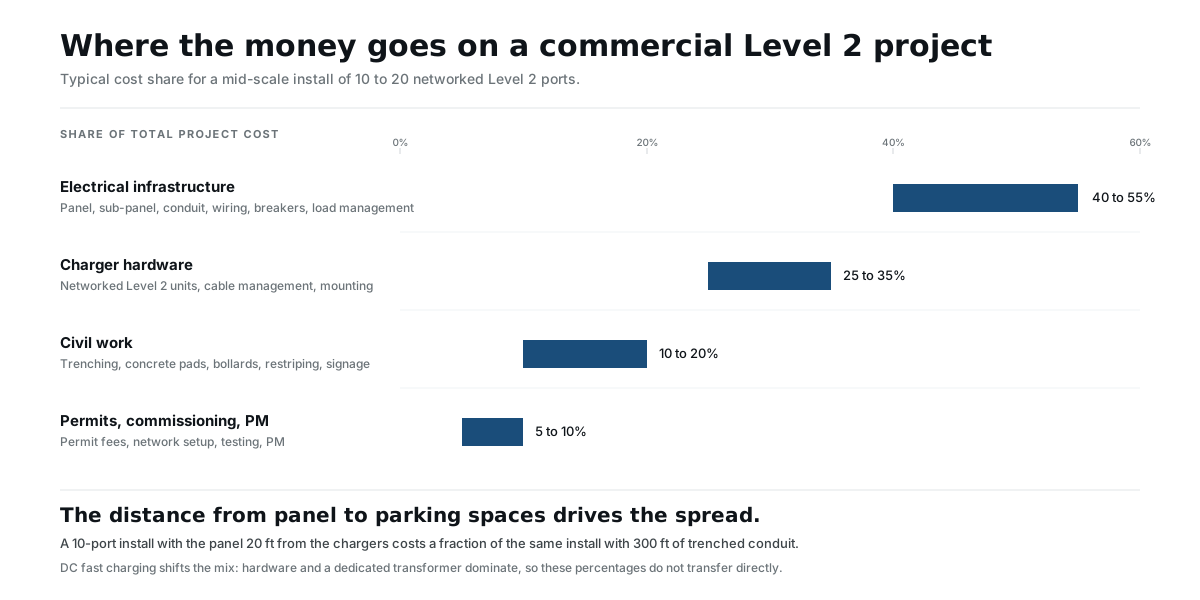
The distance between your panel and the parking spaces is the single biggest swing factor in this category. A 10-port install where the panel sits 20 feet from the chargers costs a fraction of the same install where the panel is across a large lot requiring 300 feet of trenched conduit.
The service equipment those circuits land on, the switchgear and how the utility meters it, is its own decision with utility-specific size limits that can reshape a large project. See Choosing Switchgear and Service Equipment for Commercial EV Charging.
2. Civil work
For outdoor and surface-lot installations, civil work is often required and can be a meaningful slice of the budget:
- Trenching: Underground conduit means cutting through asphalt or concrete, excavating, laying conduit, backfilling, and repaving. This is priced per linear foot and varies widely by surface type and depth.
- Concrete pads and footings: Surface-lot and pedestal-mounted chargers mount on pads or footings, usually with bollard protection.
- Striping and signage: New EV spaces need restriping and signage. Accessible EV spaces need specific dimensions, markings, and an accessible route. The federal ADA Standards do not yet set EV-specific rules, so the details come from state and local codes and the U.S. Access Board's technical guidance.
3. Charger hardware
The equipment itself. Networked commercial Level 2 hardware is a smaller share of total cost than most owners expect: the unit may be a four-figure line item, but the electrical and civil work around it usually costs more. DC fast charging flips this: the hardware becomes a major cost, often matched or exceeded by the utility service and transformer work.
4. Network commissioning
Connecting chargers to a software platform, configuring pricing and access rules, and testing end to end: session start, charging, session end, and payment processing. This is a distinct step from physically installing the hardware and is easy to underestimate in scheduling.
5. Permits and inspections
Commercial installations require permits: at minimum an electrical permit, and often a building permit for structural or civil work. ADA review is typically folded into the building-permit process. See Realistic Timelines and Delays for what to expect on review times.
Who does the work
Commercial EV projects almost always involve multiple trades.
| Role | Responsibility | Notes |
|---|
| Licensed commercial electrician | All electrical work | C-10 in California, equivalent elsewhere. Ask specifically about commercial EV experience; it differs from residential |
| Civil contractor | Trenching, concrete, paving, striping | Often a subcontractor coordinated by the electrical or general contractor |
| EV charging contractor / systems integrator | End-to-end coordination | Some firms manage electrical, civil, procurement, and commissioning as one package using licensed subs |
| Network software provider | Platform and billing | May be the hardware vendor (ChargePoint, Blink) or a third-party OCPP-compatible platform |
There is no single right structure. A general-contractor model gives you one throat to choke; a direct-trade model can be cheaper but puts coordination on you. What matters is that one party is clearly accountable for the critical path.
How costs break down
For a mid-scale project (10 to 20 Level 2 ports), the typical split looks like this:
Representative installed cost ranges (as of October 2026)
Published 2026 figures for networked commercial Level 2 cluster around $3,500 to $6,000 per port for multi-port projects that share trenching, panel work, and permitting. Single-port and complex sites run higher, commonly quoted up to $12,000+ per port. These are illustrative ranges; your number depends almost entirely on site conditions.
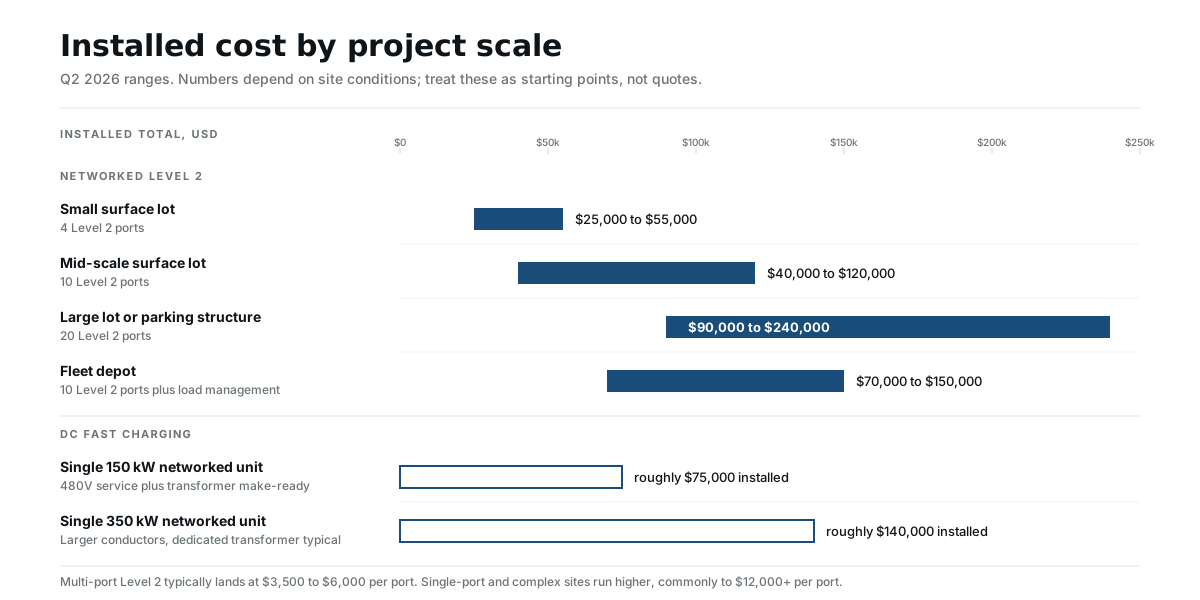
DC fast charging typically requires 480V three-phase service, large conductors, and often a dedicated transformer, which is why make-ready (the site and electrical preparation) is frequently the dominant cost rather than the charger itself. The Electrical Infrastructure Assessment is how you turn these wide ranges into a number for your specific site.
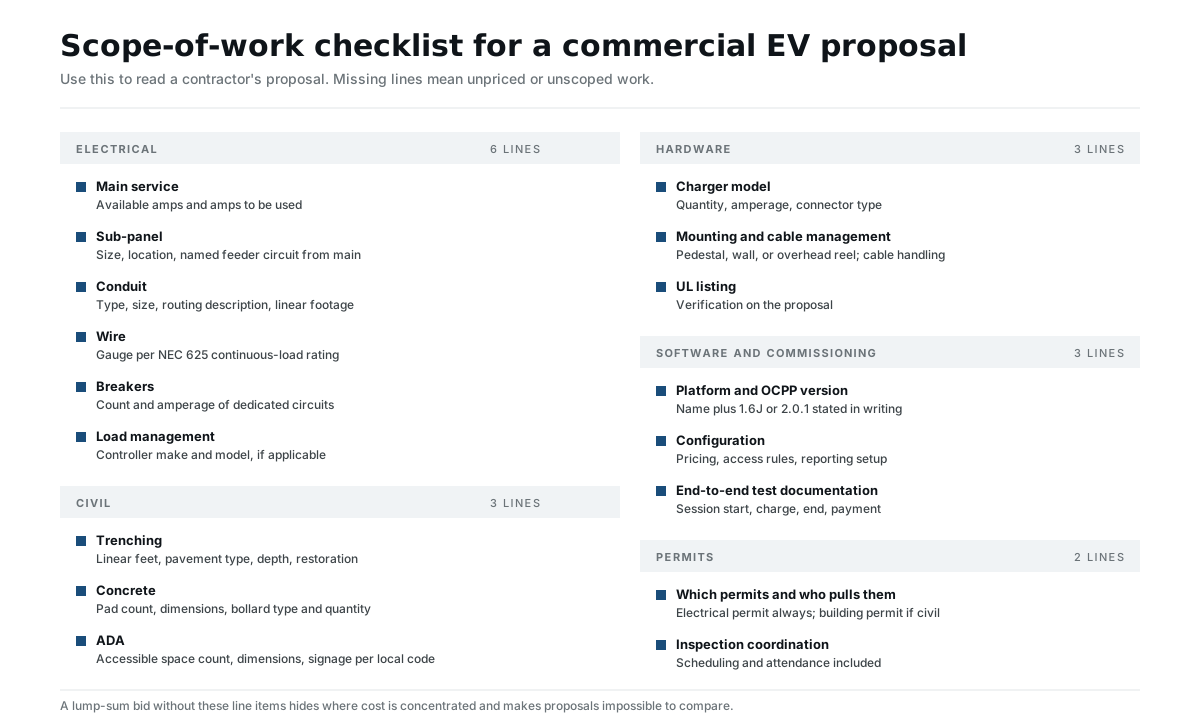
A complete scope of work
A proposal worth signing spells out every line. Use this as a template to check what you're being quoted.
Contractor vetting: questions to ask
- What is your state electrical contractor license number? (Verify it on the licensing board site.)
- How many commercial Level 2 installs have you completed in the past 12 months, and can you share references?
- Will you pull all required permits and attend inspections? (This should be non-negotiable.)
- Can you provide a line-item breakdown separating electrical, civil, hardware, and commissioning?
- Is the proposed hardware OCPP 1.6J, 2.0.1, or 2.1 compliant? (Get it in writing.)
- Is the conduit sized for future expansion, not just today's port count?
- How will you prevent demand-charge spikes from simultaneous charging starts?
- Who confirms ADA compliance for spaces and the accessible route?
- What is the realistic timeline to first charger operational, including permit and utility processing?
- What are the hardware warranty terms and your post-install support obligations?
Red flags in proposals
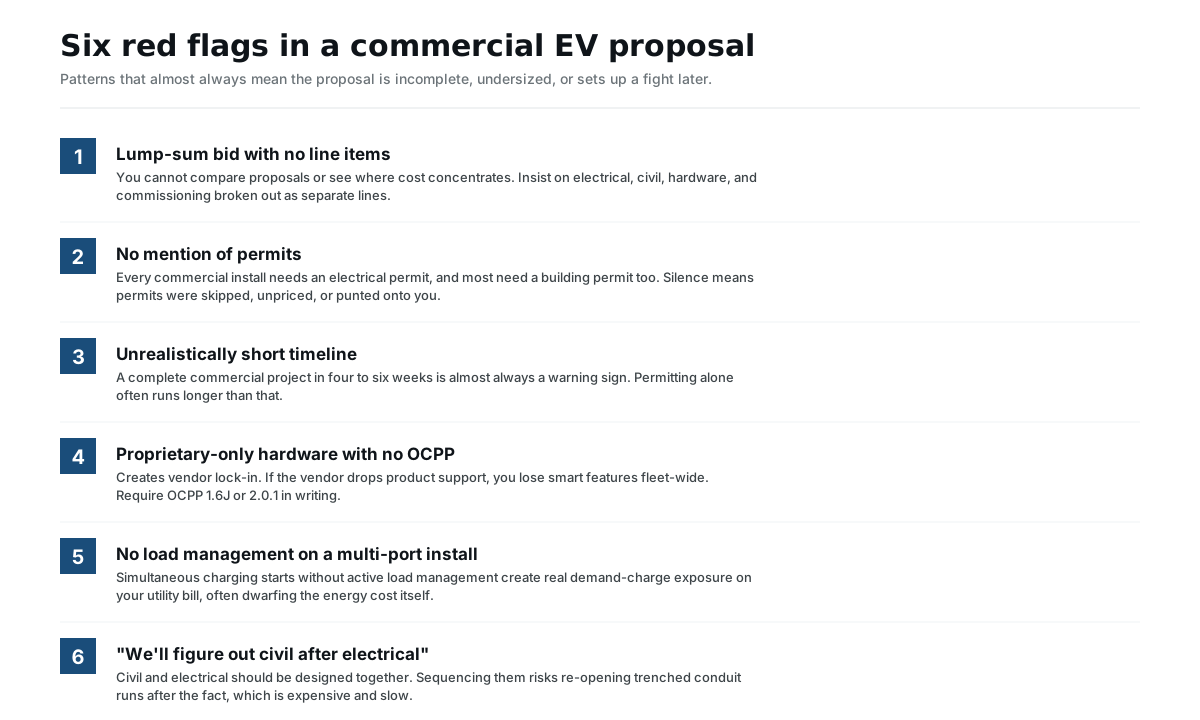
These six patterns almost always mean the proposal is incomplete, undersized, or sets up a fight later. Walk through them line by line before signing anything.
California note
If you are building new or adding parking in California, the 2025 edition of CALGreen (the green building code, Part 11 of Title 24), in effect since January 1, 2026, sets EV-capable and installed-charger minimums by occupancy type and parking count. Warehouses, grocery and retail stores, office buildings, and manufacturing facilities with planned off-street loading spaces must also provide readiness for future medium- and heavy-duty truck charging. Confirm how your project triggers these minimums before finalizing scope. Do not count on a utility rebate for behind-the-meter work: the CPUC's statewide behind-the-meter rebate program (Funding Cycle 1) has been paused since June 2024 and was still paused in the commission's December 2025 decision, and the earlier utility make-ready programs stop accepting new customer agreements by December 31, 2026. See Utility Make-Ready Programs for what is still open.
After installation
When the work is done and inspected:
- Confirm ADA spaces are marked and the accessible route is clear
- Verify charger-to-network communication is active and reporting
- Run end-to-end payment testing before opening to users
- Keep an as-built package: panel schedule, conduit routing photos, hardware serial numbers, network credentials
- Set a maintenance protocol: who gets called on a fault, and what the response time is
The documentation package matters more than most operators expect. When a charger faults two years on, or when you want to add ports, good as-builts save real time and money.
Last factually verified: 2026-10-03 against IRS.gov (Section 30C), 2023 NEC Article 625 text, 2026 commercial Level 2 and DC fast installed-cost guides (GreenLancer, August 2026; Qmerit, July 2026; EVChargeRight; Winsparking), the 2025 CALGreen nonresidential EV requirements, CPUC Decision 25-12-005 and the CPUC charging-infrastructure program page, the U.S. Access Board's EV charging technical assistance, the Open Charge Alliance's OCPP protocol page, and California's C-10 license classification.
Corrections (October 3, 2026): This article previously named the California code as a "2026 Title 24 building code"; the EV requirements are in the 2025 edition of CALGreen (Part 11 of Title 24), in effect since January 1, 2026. It also pointed readers to a utility make-ready program "funded under the CPUC's Charge Fast / FC1 framework" for behind-the-meter work; the CPUC's Funding Cycle 1 behind-the-meter rebate program has been paused since June 2024 (still paused under Decision 25-12-005, December 4, 2025), and the earlier utility programs stop accepting new customer agreements by December 31, 2026. It also showed a single 150 kW DC fast unit at roughly $75,000 installed and a 350 kW unit at roughly $140,000; current 2026 cost guides put them at roughly $90,000 to $150,000 or more and $150,000 to $250,000 or more.